Essential Trip Information
-
1 Day
-
Everest
-
2+
-
 5463M
5463M -
 Moderate
 -
Spring (Mar - May) Autumn (Sep- Nov)
-
Nepal
Extend Your Trip
Essential Packing List
As this is a short aerial excursion, heavy trekking equipment is unnecessary. Nevertheless, Himalayan temperatures can be very low, particularly during early-morning flights.
Clothing
- Thermal or moisture-wicking base layer
- Warm fleece, sweater or insulated mid-layer
- Down jacket suitable for cold conditions
- Windproof and water-resistant outer jacket
- Comfortable trousers
- Warm socks
- Woollen hat or insulated cap
- Warm gloves
Footwear
- Comfortable walking shoes or lightweight hiking boots
- Shoes with secure fastening and non-slip soles
Sun and Weather Protection
- UV-protective sunglasses, preferably with good side coverage
- High-SPF sunscreen
- Lip balm with sun protection
- Light scarf or neck gaiter
Personal Items
- Passport or valid government-issued identification
- Copies of relevant permits or booking documents
- Personal medication
- Small water bottle
- Lightweight snacks
- Tissues or wet wipes
- Small amount of local currency for personal purchases
Photography Equipment
- Camera or smartphone
- Fully charged batteries
- Spare battery or power bank
- Adequate memory-card capacity
- Protective camera pouch
- Lens cloth to manage condensation or fingerprints
Recommended Bag
Carry one compact daypack that can be safely placed in the designated helicopter storage area. Large suitcases, heavy backpacks and unnecessary equipment should be left at your hotel. All baggage remains subject to the operating company’s weight and safety restrictions.
Good to Know
1. Weather Determines the Flight
Helicopter operations in the Himalayas depend heavily on visibility, wind, cloud cover and local weather patterns. Delays, route adjustments, postponements or cancellations may occur when the pilot determines that conditions are unsuitable.
Safety decisions made by the pilot and aviation authorities are final. Keeping at least one flexible day in Kathmandu after the planned tour may therefore be helpful.
2. Departure Times May Change
Although early-morning departures are customary, the final reporting time can change according to weather forecasts, airport traffic and operational requirements. Passengers should remain available at the hotel and follow the instructions provided by the company.
3. This Is a Scenic Overflight
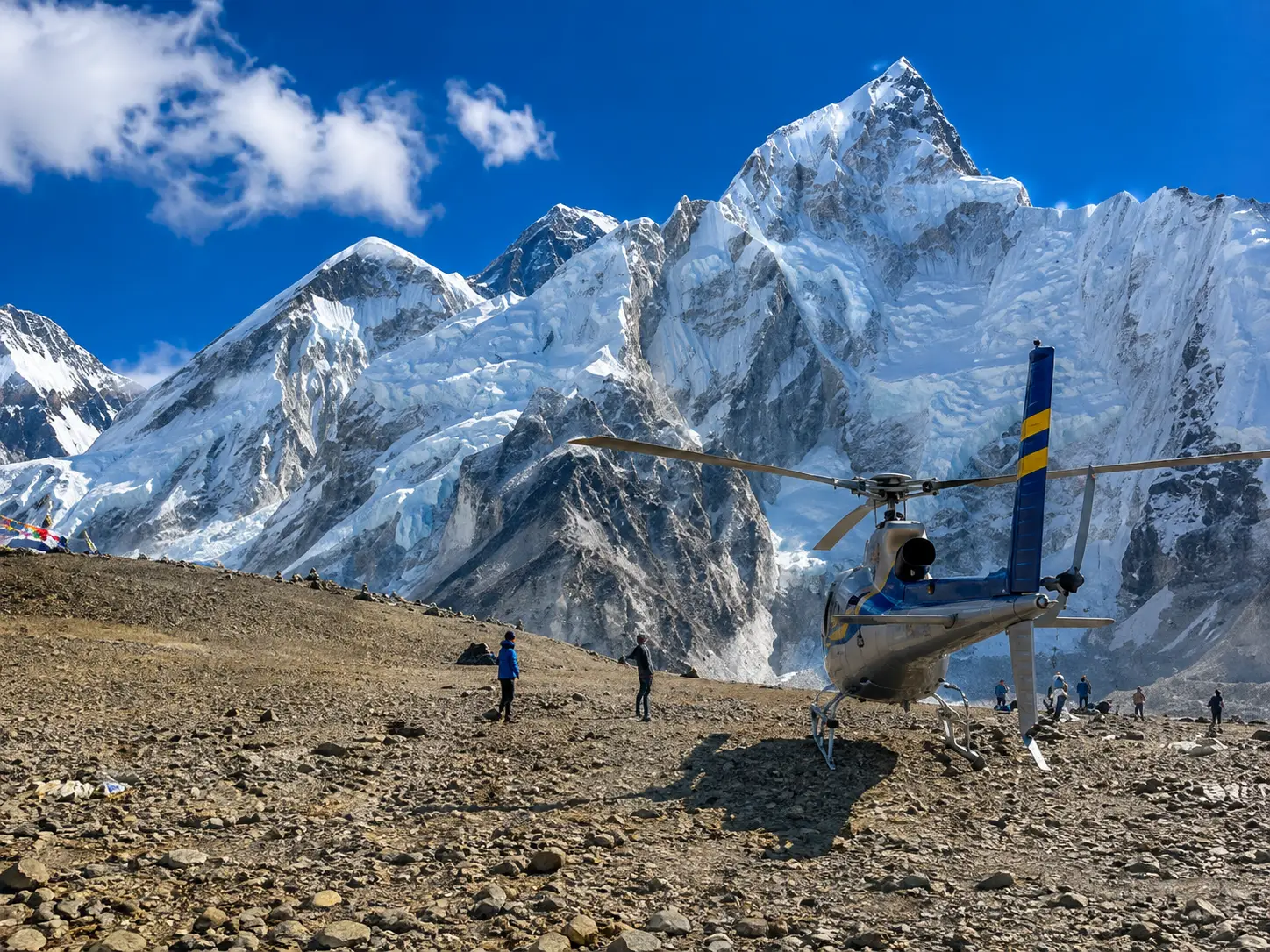
The standard programme is designed as an aerial sightseeing experience. It does not include a guaranteed landing at Everest Base Camp, Kala Patthar or another high-altitude viewpoint.
Any technical landing made for refuelling, flight management or safety reasons is controlled by the pilot and does not constitute a scheduled sightseeing stop.
4. Mountain Views Cannot Be Guaranteed
The planned route offers excellent prospects for seeing Mount Everest and the surrounding peaks. Nevertheless, cloud, haze, snowfall and rapidly changing mountain weather can partly or completely obscure individual mountains. Natural visibility is beyond the control of the tour company and helicopter operator.
5. Shared-Flight Arrangements
The standard package is operated on a shared-flight basis. Departure may depend on reaching the minimum operational passenger requirement.
The helicopter may accommodate up to five passengers, depending on the aircraft model, combined passenger weight, baggage allowance, weather and altitude-related performance limitations.
6. Seating Is Weight-Balanced
For aviation safety, the pilot and ground crew determine passenger seating according to weight distribution. A particular seat or uninterrupted window position cannot always be guaranteed.
The crew may request passengers to exchange seats during an operational stop when it is safe and practical to do so.
7. Passenger Weight Must Be Declared Accurately
Each traveller must provide an accurate body weight, including approximate clothing and hand-luggage weight, during booking. A final weight check may be conducted at the airport.
Incorrect information may affect aircraft balance, operational planning, seating allocation or the ability to participate in the flight.
8. High-Altitude Awareness
Although passengers remain inside the helicopter and do not undertake strenuous walking, the aircraft enters a high-altitude environment. Travellers may occasionally experience headache, light-headedness, breathlessness or discomfort.
Anyone with heart, lung, blood-pressure or other significant medical conditions should seek professional medical advice before booking and inform the company in advance.
9. Supplementary Oxygen
Helicopters operating on high-altitude routes generally carry safety equipment appropriate to the approved operation. The availability and use of supplementary oxygen depend on the aircraft, operating company and pilot’s procedures. Passengers should not assume that routine oxygen use is included unless it has been confirmed in writing.
10. Travel Insurance Is Strongly Recommended
Passengers should obtain comprehensive insurance covering trip cancellation, medical treatment, aviation-related disruption and emergency evacuation where applicable. Insurance terms vary, so travellers should verify that the selected policy covers their planned activities and destination.
11. Identification and Permits
Every passenger must carry a valid passport or other accepted identification. Depending on current regulations and the approved flight route, national park, local-government or airport permissions may be required.
Our team can assist with permit arrangements; however, the relevant fees are payable separately unless the confirmed package explicitly states otherwise.
12. Photography Etiquette
Photography is encouraged, but loose equipment should remain secured. Passengers must not use flash photography near the pilot, obstruct flight controls or move suddenly while the helicopter is operating.
Dark clothing may reduce reflections when taking photographs through the helicopter windows.
13. Children and Senior Travellers
The tour may be suitable for children and older travellers because it does not involve prolonged trekking. Participation should nevertheless be assessed individually, particularly when a passenger has an existing medical condition or difficulty tolerating altitude, cold or aircraft movement.
Children must remain under the supervision of a responsible adult throughout the experience.
14. Motion Sensitivity
Passengers who are susceptible to motion sickness may wish to consult a medical professional about suitable preventive medication. Eating a light meal before departure and avoiding alcohol the previous evening may also help.
15. Responsible Himalayan Travel
The Everest region is environmentally fragile and culturally significant. Passengers should avoid leaving rubbish, respect flight-safety instructions and behave considerately during any operational stop.
Himalayan Sherpa Exodus Team supports travel practices that respect local communities, mountain environments and Nepal’s aviation regulations.
Suggested Route Map
Kathmandu → Lukla area → Dudh Koshi Valley → Namche Bazaar → Tengboche area → Pheriche/Dingboche Valley → Lobuche → Gorak Shep → Everest Base Camp and Kala Patthar overflight → return via the Khumbu Valley → Kathmandu
The displayed route is indicative. The pilot may modify the flight path because of weather, visibility, aircraft performance, air-traffic instructions or regulatory requirements.
Why Travel with Himalayan Sherpa Exodus Team?
At Himalayan Sherpa Exodus Team Treks & Expeditions Pvt. Ltd., we believe that a Himalayan journey should be memorable for the right reasons. Our approach combines attentive local coordination, honest communication and respect for the operational realities of mountain aviation.
From hotel pickup to the final airport transfer, our team remains available to assist with flight confirmation, documentation and practical preparation. We do not treat the Everest region merely as a sightseeing destination. It is a living cultural landscape shaped by Sherpa communities, mountain traditions and a delicate alpine environment.
Our purpose is to help guests encounter this remarkable region safely, respectfully and meaningfully.
Important Operational Notice
All helicopter flights are subject to weather conditions, aircraft availability, passenger-weight limits, airport operations, government regulations and the pilot’s final decision. The itinerary, flight path and duration may be altered without prior notice when required for safety or legal compliance.
No landing at Everest Base Camp or Kala Patthar is included in this standard overflight programme. Prices, permit requirements, airport taxes and operating procedures should be reconfirmed at the time of booking.