Kanchenjunga South BC Yalung
Trip Overview
The 13 Days Kanchenjunga South Base Camp Trek is an unforgettable adventure into the remote and pristine landscapes of eastern Nepal, leading trekkers to the magnificent southern face of the world’s third-highest mountain, Mt. Kanchenjunga (8,586m). Designed for nature lovers, photographers, and adventure seekers, this journey combines dramatic mountain scenery, untouched forests, authentic Himalayan villages, and rich cultural encounters into one rewarding trekking experience.
Your adventure begins with a scenic flight from Kathmandu to Bhadrapur, followed by an overland drive to Suketar, the gateway to the Kanchenjunga Conservation Area. The trail gradually passes through picturesque settlements, lush rhododendron and bamboo forests, terraced farmland, and traditional villages inhabited by Limbu, Rai, Sherpa, and other ethnic communities, offering an authentic glimpse into the diverse culture and lifestyle of eastern Nepal.
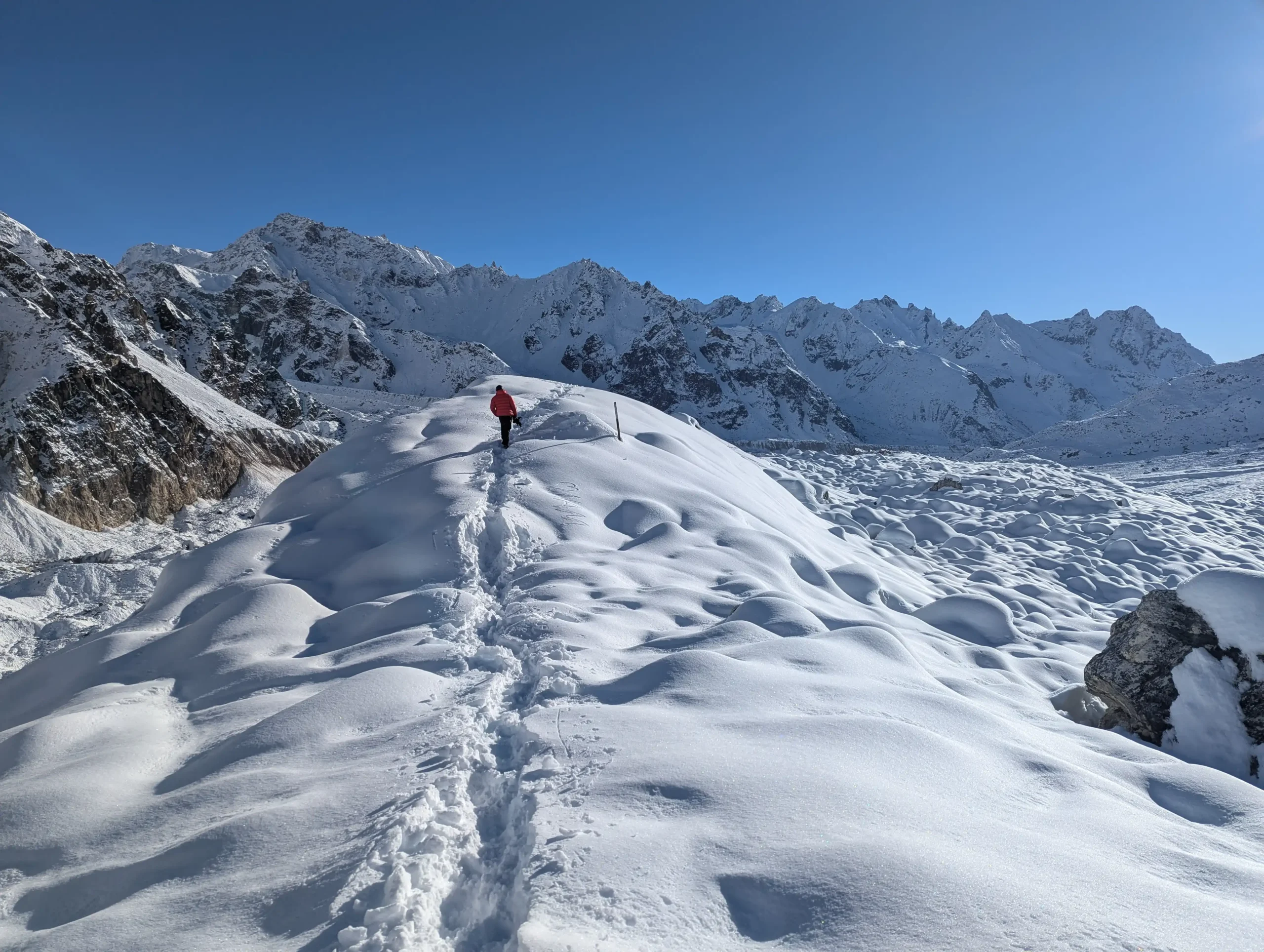
As the trek ascends deeper into the Yalung Valley, the landscapes become increasingly dramatic. Dense forests give way to alpine meadows, glacial rivers, cascading waterfalls, and towering snow-covered peaks. The route reaches the peaceful settlement of Ramche before continuing to Oktang Viewpoint (4,730m), one of the finest viewpoints in the region. Here, trekkers are rewarded with breathtaking panoramic views of Kanchenjunga’s massive south face along with neighboring peaks such as Kabru, Rathong, Kokthang, and Talung.
The adventure continues to the remarkable Yalung Ri Base Camp (4,840m), a spectacular location surrounded by glaciers, moraines, and towering Himalayan giants. Unlike Nepal’s busier trekking regions, Kanchenjunga remains wonderfully untouched, allowing visitors to experience true wilderness, peaceful trails, and an extraordinary connection with nature.
Throughout the trek, experienced guides from Himalayan Sherpa Exodus Team Treks & Expeditions Pvt. Ltd. ensure a safe, comfortable, and enriching journey. Their local knowledge, personalized service, and commitment to responsible tourism allow trekkers to fully appreciate the natural beauty, cultural heritage, and ecological significance of the Kanchenjunga Conservation Area.
Whether you seek dramatic Himalayan scenery, authentic local culture, remote wilderness, or a challenging trekking adventure, the 13 Days Kanchenjunga South Base Camp Trek offers an extraordinary journey through one of Nepal’s last truly unspoiled mountain regions, creating memories that last a lifetime.
Trip Highlights
Trip Highlights
- Experience an adventurous 13-day trekking journey to the spectacular Kanchenjunga South Base Camp.
- Witness awe-inspiring views of Mt. Kanchenjunga (8,586m), the world's third-highest mountain.
- Visit the breathtaking Oktang Viewpoint (4,730m) with panoramic Himalayan vistas.
- rek to the scenic Yalung Ri Base Camp (4,840m) surrounded by glaciers and towering peaks.
- Explore the remote and unspoiled wilderness of the Kanchenjunga Conservation Area.
- Walk through lush rhododendron, bamboo, pine, and alpine forests rich in biodiversity.
- Cross beautiful rivers, suspension bridges, waterfalls, and pristine mountain valleys.
- Discover authentic Limbu, Rai, Sherpa, and other indigenous mountain communities.
- Experience traditional Himalayan hospitality in charming local teahouses.
- Enjoy peaceful trekking trails far from the crowded commercial trekking routes.
- Observe diverse wildlife including Himalayan birds, musk deer, red pandas (rarely spotted), and other native species.
- Capture incredible sunrise and sunset views over snow-capped Himalayan peaks.
- Experience dramatic changes in landscapes—from subtropical forests to alpine glaciers.
- Follow ancient trade and pilgrimage routes through eastern Nepal.
- Travel with experienced local guides from Himalayan Sherpa Exodus Team Treks & Expeditions.
- Enjoy a perfect combination of adventure, nature, culture, photography, and wilderness exploration.
- Begin and conclude the journey with scenic flights between Kathmandu and Bhadrapur.
- Create unforgettable memories in one of Nepal's least-explored and most rewarding trekking destinations.
Day 01 :
Arrival in Kathmandu, Nepal
Elevation: approximately 1,350 m / 4,429 ft
Activity: Airport arrival and trek briefing
Accommodation: Hotel in Kathmandu
Welcome to Nepal. On arrival at Tribhuvan International Airport, a representative from Himalayan Sherpa Exodus Team Treks & Expeditions Pvt. Ltd. will receive you and arrange your transfer to the hotel.
Kathmandu provides a striking contrast to the wilderness that awaits in eastern Nepal. It is the country's principal political and cultural centre, where historic neighbourhoods, temple courtyards and traditional Newar architecture coexist with the energy of a modern Himalayan capital.
After checking in, there will be time to rest following your international journey. Later, the trek leader will conduct a detailed pre-trek briefing covering the route, high-altitude considerations, weather conditions, equipment, luggage arrangements, permits and travel logistics.
The evening is kept relaxed so that you can recover before the journey east begins.
Overnight: Kathmandu
Day 02 :
Fly from Kathmandu to Bhadrapur and Drive to Phidim
Kathmandu: approximately 1,350 m
Bhadrapur: approximately 90 m
Phidim: approximately 1,185 m
Flight: about 45 minutes
Drive: approximately 5–6 hours
Accommodation: Local hotel/lodge
After breakfast, we transfer to Kathmandu airport for the morning flight to Bhadrapur, situated in Nepal's southeastern lowlands.
The flight is relatively short, normally around 45 minutes, but it produces a dramatic geographical transition. Leaving the Kathmandu Valley, we cross Nepal toward the humid eastern Terai before landing near the Indian border. Flights between Kathmandu and Bhadrapur commonly form the main access route for Kanchenjunga itineraries.
From Bhadrapur, our overland journey begins through eastern Nepal. Gradually leaving the tropical plains behind, the road climbs through tea-growing country, river valleys and forested middle hills toward Phidim, the administrative centre of Panchthar District. Road conditions can substantially influence the journey time.
Phidim is a lively eastern hill settlement surrounded by agricultural slopes and scattered villages. Here, the climate becomes noticeably cooler than Bhadrapur, and the landscape begins to resemble the hill country through which we will travel toward Taplejung.
Overnight: Phidim
Day 03 :
Drive from Phidim to Taplejung and Continue to Yamphudin/Yasang
Destination elevation: approximately 2,080 m / 6,824 ft
Driving duration: approximately 8–10 hours, depending on road conditions
Walking: normally minimal, although a short approach walk may be required if the seasonal road ends before the lodge
Accommodation: Basic teahouse/lodge
Today takes us deeper into the hills of far-eastern Nepal.
Leaving Phidim, the road winds through cultivated slopes, small market settlements, river valleys and forest-covered ridges toward Taplejung, the traditional gateway to the Kanchenjunga region.
From Taplejung, we continue toward the southern approach of the Kanchenjunga trekking area, travelling as far as seasonal road conditions permit toward Yamphudin, locally associated with the southern trekking entrance.
Road access in this region has expanded considerably, although travel times remain highly variable because mountain roads are vulnerable to monsoon damage, landslides and seasonal deterioration. Several contemporary Kanchenjunga itineraries now use road transport to reach or leave Yamphudin.
Yamphudin is considerably more than a trail stop. It lies within the inhabited lower Kanchenjunga landscape, where farming remains central to everyday life and houses are dispersed among terraces and wooded hillsides. The settlement is also associated with a Kanchenjunga Conservation Area checkpoint on the southern route.
The evening is spent preparing for the first substantial day on foot.
Overnight: Yamphudin/Yasang
Day 04 :
Trek from Yamphudin to Tortong
Yamphudin: approximately 2,080 m
Tortong: approximately 2,995 m / 9,826 ft
Walking distance: approximately 10–13 km
Walking duration: approximately 6–8 hours
Accommodation: Basic teahouse
Our real trekking journey begins today.
From Yamphudin, the trail leaves the inhabited agricultural zone and climbs progressively into a wilder landscape. The terrain is characteristically Himalayan rather than uniformly uphill. There are sections of ascent, forested traverses and occasional descents before further climbing.
Vegetation becomes increasingly dense as we enter forests of rhododendron, oak, bamboo and other temperate species. Depending upon the season, streams descend from the surrounding ridges and moisture can make certain forest sections slippery.
The human landscape also changes. Permanent settlements become sparse, replaced by isolated shelters and seasonal trekking stops. The day's destination, Tortong, sometimes written Torongding or Torontan on different maps and itineraries, is a small mountain stopping place rather than a substantial village.
By evening, the sense of remoteness becomes pronounced. The cultivated hills of Yamphudin have disappeared behind us and the upper Kanchenjunga environment begins to dominate the journey.
Overnight: Tortong
Day 05 :
Trek from Tortong to Ramche/Ramchaur via Tseram
Tortong: approximately 2,995 m
Tseram/Cheram: approximately 3,870 m
Ramche/Ramchaur: approximately 4,580 m / 15,026 ft
Approximate walking distance: 18–20 km
Walking duration: approximately 8–10 hours
Net elevation gain: approximately 1,585 m
Accommodation: Very basic high-altitude teahouse
This is the most physically demanding ascent of the itinerary and requires an early start.
From Tortong, we follow the upper valley through dense forest, initially gaining altitude beside the river system draining the southern Kanchenjunga basin. The character of the vegetation changes steadily as elevation increases. Tall woodland gradually gives way to shorter alpine vegetation, exposed slopes and increasingly open mountain terrain.
We reach Tseram, or Cheram, at approximately 3,870 m, an important staging point in the southern Kanchenjunga valley. From here, the trail continues higher toward Ramche. Tseram to Ramche alone is commonly described as roughly 7 km and normally takes around three to four hours.
Approaching Ramche, the forest finally falls away and an austere Himalayan landscape appears. Alpine meadows, moraine formations, rocky slopes and glacially shaped terrain replace the greenery of the lower valley.
At approximately 4,580 m, Ramche is a tiny high-altitude seasonal settlement with basic trekking accommodation. Facilities are simple, but the location is extraordinary. The great mountains of the Kanchenjunga southern basin now rise around us, and the nearby Yalung Glacier becomes a defining element of the landscape.
Important acclimatization consideration
This itinerary combines the more commonly separated Tortong–Tseram and Tseram–Ramche stages into one long day. It therefore represents a rapid altitude gain. For safety, Himalayan Sherpa Exodus Team should retain the operational flexibility to stop overnight at Tseram if any member shows unusual fatigue or symptoms associated with altitude.
Overnight: Ramche
Day 06 :
Explore Ramche and Hike to Oktang Viewpoint
Ramche: approximately 4,580 m
Oktang: approximately 4,730 m / 15,518 ft
Walking distance: approximately 6–8 km round trip, depending on exploration
Walking duration: approximately 4–5 hours
Accommodation: High-altitude teahouse at Ramche
Today is reserved for exploring the remarkable upper Yalung Valley while also allowing our bodies additional time to adapt to the altitude.
After breakfast, we walk gradually beyond Ramche into a landscape almost entirely shaped by ice, rock and altitude. Vegetation becomes sparse. Moraine ridges, glacial debris and the broad mountain basin lead toward Oktang, one of the most celebrated viewpoints on Kanchenjunga's southern side.
The hike from Ramche to Oktang generally takes approximately one to one and a half hours in one direction, although at this altitude we deliberately maintain a slow and controlled pace.
At approximately 4,730 m, Oktang overlooks the immense Yalung Glacier and provides a close perspective of the southern Kanchenjunga massif. The high cirque includes Kanchenjunga's southern wall together with an impressive concentration of surrounding Himalayan summits.
Rather than rushing back, we allow time for photography, observation and acclimatization before gradually returning to Ramche.
The afternoon is intentionally quiet. Warm fluids, adequate food and rest are particularly important at this elevation.
Overnight: Ramche
Day 07 :
Sunrise Excursion toward the Yalung Glacier/South Base Camp Area and Descend to Tseram
Ramche: approximately 4,580 m
High point: approximately 4,700–4,800 m depending on safe trail access
Yalung Base Camp area: commonly referenced around 4,500 m, although mapping and naming vary
Tseram: approximately 3,870 m
Walking distance: approximately 12–16 km
Walking duration: approximately 6–8 hours
Accommodation: Teahouse at Tseram
Before sunrise, we prepare for one of the journey's most memorable mornings.
When weather and trail conditions are favourable, we walk into the upper Yalung basin while the first light begins to reach the surrounding Himalayan walls. The landscape at this hour can be exceptionally dramatic as early sunlight moves across the snowfields while the glacier valley remains in shadow.
This area requires some clarification because different trekking maps and operators use the names Oktang, Yalung Base Camp and Kanchenjunga South Base Camp differently. Oktang at roughly 4,730 m is widely used as the principal trekking viewpoint, while references to Yalung Base Camp place it farther within the glacial basin.
For this reason, our exact turnaround point is determined by the guide according to snow, glacier, moraine, visibility and trail conditions. We do not enter unstable glacial terrain merely to achieve a nominal destination.
Following the morning excursion, we return toward Ramche and begin the descent to Tseram/Cheram.
Descending approximately 700 metres provides noticeably denser air. The rocky alpine environment gradually softens, with grasses and shrubs becoming more evident as Tseram approaches.
After several intense days at altitude, the lower sleeping elevation is usually welcome.
Overnight: Tseram
Day 08 :
Trek from Tseram to Tortong
Tseram: approximately 3,870 m
Tortong: approximately 2,995 m
Walking distance: approximately 13 km
Walking duration: approximately 5–6 hours
Accommodation: Teahouse
We now begin our return through the southern Kanchenjunga valley.
From Tseram, the trail descends steadily away from the high alpine zone. Within a comparatively short distance, the environment changes dramatically. Bare slopes and alpine vegetation give way first to shrubs and then to increasingly dense forest.
The descent from Tseram to Tortong is generally estimated at about 13 km, with much of the route moving downhill through the forested valley.
Rhododendron woodland again becomes prominent, and the warmer air provides an immediate contrast with Ramche. Streams, moss-covered rocks and forest shade create an entirely different atmosphere from the open glacial country experienced during the previous two days.
We reach Tortong during the afternoon and settle into our simple mountain lodge.
Overnight: Tortong
Day 09 :
Trek from Tortong to Yamphudin/Yasang
Tortong: approximately 2,995 m
Yamphudin: approximately 2,080 m
Walking distance: approximately 9–14 km
Walking duration: approximately 6–7 hours
Accommodation: Local lodge
Today's route reconnects the mountain wilderness with the inhabited middle hills.
Leaving Tortong, the trail crosses forested slopes and follows a mixture of descent and shorter climbs. Although the destination lies substantially lower, this is not simply an easy downhill walk. Sections can be steep, particularly where the path crosses ridges and tributary valleys.
Published route estimates vary from approximately 9 to 14 km, while trekking time generally remains around six to seven hours because of the nature of the terrain.
As we approach Yamphudin, farmland reappears. Terraces cut into the hillsides, permanent houses become more frequent and the sounds of village life replace the isolation of the upper valley.
After days of very basic high-altitude accommodation, returning to an established village feels like a significant transition in the journey.
Overnight: Yamphudin/Yasang
Day 10 :
Yamphudin to Kanyam, Ilam
Yamphudin: approximately 2,080 m
Kanyam: approximately 1,200–1,300 m
Walking: approximately 0–2 hours where necessary to reach the seasonal jeep road-head
Drive: approximately 7–9 hours
Accommodation: Hotel/lodge at Kanyam
After breakfast, we leave the trekking trail and begin our long overland return toward Ilam.
Depending upon the condition and seasonal extension of the road, there may be a short walk from Yamphudin to the point accessible by jeep. From there, we drive through a succession of mountain villages, river valleys and cultivated hills.
Contemporary Kanchenjunga itineraries generally allow around eight hours for the Yamphudin–Kanyam journey, although road conditions can alter this considerably.
Gradually, the rugged Taplejung landscape gives way to the greener and more intensively cultivated hills of Ilam District.
Our destination is Kanyam, renowned for its rolling tea estates. The neatly patterned tea gardens spread across the hillsides, providing a peaceful and visually striking contrast to the raw glacial landscapes of Kanchenjunga.
The evening is free to relax and enjoy the cooler tea-country environment.
Overnight: Kanyam, Ilam
Day 11 :
Explore the Ilam Tea Gardens and Drive to Bhadrapur
Kanyam: approximately 1,200–1,300 m
Bhadrapur: approximately 90 m
Exploration: 1–2 hours
Drive: approximately 3–4 hours
Accommodation: Hotel in Bhadrapur
This morning is intentionally unhurried.
We explore the Kanyam tea gardens, where rows of tea bushes follow the natural contours of the hills. Depending on the season, workers may be seen tending or harvesting the tea leaves.
After experiencing one of eastern Nepal's characteristic agricultural landscapes, we continue downhill toward the plains.
The geographical transition is again striking. The temperate hills gradually disappear and the air becomes warmer as the road approaches Jhapa District and the eastern Terai.
We arrive in Bhadrapur with enough time to rest before tomorrow's flight. Staying overnight near the airport also provides a practical buffer against unpredictable mountain-road delays.
Overnight: Bhadrapur
Day 12 :
Fly from Bhadrapur to Kathmandu
Bhadrapur: approximately 90 m
Kathmandu: approximately 1,350 m
Flight duration: approximately 45 minutes
Accommodation: Hotel in Kathmandu
After breakfast, we transfer to Bhadrapur Airport for the return flight to Kathmandu.
The flight normally takes about 45 minutes, bringing us quickly back across Nepal after the long overland and trekking journey through the east.
Upon arrival, our representative transfers you to the hotel.
The remainder of the day is free. You may simply rest, explore the streets around your hotel, shop for souvenirs, or enjoy one final evening in Kathmandu.
In the evening, depending upon the trip arrangement, the Himalayan Sherpa Exodus Team may organize a farewell gathering to celebrate the completion of the Kanchenjunga journey.
Overnight: Kathmandu
Day 13 :
Final Departure from Nepal
Activity: International airport transfer
Meals/Accommodation: According to departure schedule
Your 13-day Kanchenjunga South Base Camp adventure comes to an end today.
At the appropriate time, a representative from Himalayan Sherpa Exodus Team Treks & Expeditions Pvt. Ltd. will transfer you to Tribhuvan International Airport for your onward international flight.
You leave Nepal having travelled from its subtropical eastern plains through agricultural hill communities, deep Himalayan forests and remote alpine valleys to the glacial world beneath Kanchenjunga.
Although the trek ends in Kathmandu, the memories of sunrise above the Yalung Valley, the immense southern face of Kanchenjunga, the silence around Ramche and the hospitality encountered across eastern Nepal are likely to remain long after the journey home.
The Kanchenjunga South Base Camp Trek leads into one of the least-commercialized mountain landscapes of eastern Nepal, approaching the southern face of Mount Kanchenjunga, 8,586 m, the world’s third-highest mountain. The massif rises along the Nepal-Sikkim frontier, while the Nepal-side trekking route passes through the remote valleys and mountain settlements of Taplejung.
Unlike Nepal’s busier trekking corridors, this journey changes character quickly. The approach begins among cultivated hills and inhabited villages, enters deep rhododendron and conifer forests, and finally reaches the exposed alpine basin around Tseram, Ramche, the Yalung Glacier and Oktang. Ramche is generally placed at about 4,580 m, while Oktang, widely regarded as the principal Kanchenjunga South Base Camp viewpoint, is approximately 4,730 m.
The following itinerary has been freshly written specifically for Himalayan Sherpa Exodus Team It is intentionally presented in a practical briefing style rather than using generic trekking-company descriptions.
Route note: Walking distances and driving times in the Kanchenjunga region should always be treated as approximate. Trail conditions, road extensions, landslides, weather, acclimatization and the location of the seasonal jeep road-head can alter the day’s actual distance and duration.
KBC South
The Trip Package Cost Includes
- Airport arrival and departure transfers by private vehicle.
- Two-way domestic flights between Kathmandu and Bhadrapur.
- Private ground transportation between Bhadrapur and Suketar/Taplejung as per the itinerary.
- All required trekking permits, including the Kanchenjunga Conservation Area Permit (KCAP) and Restricted Area Permit (RAP).
- Experienced, government-licensed English-speaking trekking guide.
- Strong and reliable porter service (1 porter shared between two trekkers).
- Accommodation in local teahouses/lodges during the trek.
- Hotel accommodation in Kathmandu (as per the itinerary).
- Three meals a day (breakfast, lunch, and dinner) during the trekking period.
- Seasonal fresh fruits after dinner during the trek.
- Guide and porter salary, meals, accommodation, insurance, transportation, and equipment.
- Comprehensive first-aid medical kit carried by the guide.
- Sleeping bag and duffel bag (returned after the trek if provided by the company).
- Official company T-shirt or trekking souvenir.
- Government taxes and company service charges.
- Trek completion certificate issued by Himalayan Sherpa Exodus Team Treks & Expeditions Pvt. Ltd.
The Trip Package Cost Excludes
- Nepal entry visa fees.
- International airfare to and from Nepal.
- Travel insurance covering emergency helicopter evacuation, medical treatment, and trip cancellation.
- Lunch and dinner in Kathmandu.
- Personal trekking equipment and clothing.
- Hot showers, Wi-Fi, battery charging, and laundry services at teahouses.
- Alcoholic beverages, soft drinks, bottled water, snacks, and personal refreshments.
- Personal expenses such as shopping, souvenirs, and tips.
- Additional accommodation due to flight delays, weather conditions, natural disasters, or personal reasons.
- Extra expenses caused by itinerary changes beyond the company's control.
- Tips for the guide, porter, and driver (tipping is customary and greatly appreciated).
Best Time to Trek
The Kanchenjunga South Base Camp Trek can be completed during most trekking seasons, but two periods offer the most favorable conditions.
Spring (March to May)
Spring is considered one of the finest seasons for this trek. Rhododendron forests burst into colorful bloom, temperatures remain comfortable, and mountain views are generally excellent. Wildlife is more active, making the trail especially attractive for photographers and nature enthusiasts.
Autumn (Late September to November)
Autumn provides crystal-clear skies, stable weather, and outstanding visibility of Kanchenjunga and neighboring Himalayan peaks. Dry trails and pleasant daytime temperatures make this the most popular trekking season.
Winter (December to February)
Winter trekking is possible for experienced trekkers prepared for freezing temperatures and occasional snowfall at higher elevations. The trails are quieter, offering a peaceful wilderness experience.
Monsoon (June to August)
Heavy rainfall can make lower trails muddy and slippery, while clouds often reduce mountain visibility. Landslides and leeches are also more common during this period, making it the least recommended season.
KTM – BDP – KTM Flight Information
Your adventure begins with a scenic domestic flight from Kathmandu (KTM) to Bhadrapur (BDP), lasting approximately 45 minutes. On clear days, passengers enjoy spectacular aerial views of the eastern Himalayas, rolling hills, and fertile plains.
After landing in Bhadrapur, a long but scenic drive takes you through Ilam’s famous tea gardens, picturesque villages, and winding mountain roads before reaching Suketar, the gateway to the Kanchenjunga region.
At the end of the trek, you return by road to Bhadrapur before taking another short flight back to Kathmandu. Although domestic flights generally operate as scheduled, delays or cancellations may occur due to mountain weather. We recommend allowing an extra day in Kathmandu after the trek if you have an international connection.
Trek Difficulty
The 13 Days Kanchenjunga South Base Camp Trek is classified as a moderately challenging to strenuous Himalayan trek. It is suitable for trekkers with good physical fitness who enjoy long walking days in remote mountain terrain.
Daily trekking typically ranges between 4 and 9 hours, with several steep ascents and descents through forests, alpine valleys, and rugged mountain trails. Unlike Nepal’s more commercial trekking routes, facilities are basic, and the region remains wonderfully remote.
Previous high-altitude trekking experience is helpful but not mandatory. With regular cardiovascular exercise, strength training, and adequate preparation before the trip, most healthy trekkers can successfully complete the journey.
Acclimatization & Altitude Sickness
Although the Kanchenjunga South Base Camp Trek reaches a maximum elevation of approximately 4,840 meters at Yalung Ri Base Camp, proper acclimatization remains essential for a safe and enjoyable experience.
Our itinerary is designed with gradual altitude gain, allowing your body sufficient time to adapt naturally. Staying well hydrated, eating balanced meals, walking at a comfortable pace, and avoiding alcohol at higher elevations all help reduce the risk of Acute Mountain Sickness (AMS).
Professional guides from Himalayan Sherpa Exodus Team closely monitor every trekker for signs of altitude-related illness. If symptoms become serious, the safest solution is immediate descent and, when necessary, emergency evacuation.
Himalayan Culture & Ancient Monasteries
Beyond its spectacular mountain scenery, the Kanchenjunga region offers a rich cultural experience shaped by centuries of Himalayan tradition. Throughout the trek, you’ll pass welcoming villages inhabited by Limbu, Rai, Sherpa, and other indigenous communities, each preserving unique customs, festivals, architecture, and traditional ways of life.
Prayer flags flutter above suspension bridges, mani walls and chortens decorate the trails, and small Buddhist monasteries provide peaceful places for reflection. These sacred sites continue to serve as important spiritual centers where local people gather for daily prayers and religious ceremonies.
The warmth and hospitality of the mountain communities add a meaningful cultural dimension to the journey, allowing trekkers to experience not only Nepal’s breathtaking landscapes but also the enduring traditions and spiritual heritage of the eastern Himalayas.
Preparation Guide
Proper preparation is the key to enjoying a safe and rewarding 13 Days Kanchenjunga South Base Camp Trek. As this trek explores one of Nepal’s most remote Himalayan regions, trekkers should begin physical training at least 6–8 weeksbefore departure. Regular hiking, jogging, cycling, stair climbing, and strength exercises help build endurance for long trekking days.
Carry quality trekking gear suitable for changing mountain weather, including waterproof clothing, warm layers, and sturdy trekking boots that have already been broken in. Staying hydrated, maintaining a balanced diet, and getting enough rest before the trek will also improve your overall performance at higher elevations.
Our experienced team at Himalayan Sherpa Exodus Team provides a detailed pre-departure briefing to ensure you are fully prepared for this unforgettable Himalayan adventure.
Weather & Climate
The Kanchenjunga region experiences diverse weather conditions due to its wide range of elevations, from subtropical valleys to alpine landscapes.
During spring (March to May), daytime temperatures generally range between 10°C and 20°C at lower elevations, while higher camps remain much cooler. Rhododendron forests bloom beautifully, creating colorful landscapes.
In autumn (September to November), stable weather and crystal-clear skies offer excellent mountain visibility. Daytime temperatures are pleasant, while nights become cold above 3,500 meters.
Winter (December to February) brings freezing temperatures, occasional snowfall, and icy trails at higher elevations. Monsoon (June to August) brings frequent rain, muddy trails, and reduced mountain views, making it the least favorable season for trekking.
Mountain weather can change rapidly at any time of year, so trekkers should always be prepared for varying conditions.
Accommodation
Accommodation during the Kanchenjunga South Base Camp Trek is provided in locally operated teahouses and mountain lodges. These lodges offer a warm and authentic Himalayan experience while supporting local communities.
Rooms are generally simple, featuring twin beds with mattresses, pillows, and blankets. At lower elevations, some lodges offer attached bathrooms, while higher-altitude teahouses usually provide shared toilet facilities. Dining halls are heated with traditional stoves during the evening, creating a comfortable gathering place after each day’s trek.
Although accommodation is more basic than on popular trekking routes such as Everest or Annapurna, the genuine hospitality of local hosts makes the experience truly memorable.
Meals During the Trek
Nutritious meals are essential for maintaining energy throughout the trek. Teahouses serve freshly prepared meals using locally available ingredients.
Breakfast options typically include Tibetan bread, chapati, porridge, eggs, pancakes, muesli, toast, tea, and coffee. Lunch and dinner menus often feature Dal Bhat, fried rice, noodles, pasta, soups, potatoes, momos, vegetables, curry dishes, and seasonal fruits when available.
Dal Bhat remains the most popular trekking meal because it provides an excellent balance of carbohydrates, protein, and vegetables while offering unlimited refills at many teahouses.
Vegetarian meals are widely available throughout the trek, and it is generally recommended to avoid meat at higher elevations due to limited refrigeration facilities.
Drinking Water
Staying hydrated is extremely important during high-altitude trekking. Trekkers should aim to drink 3–4 liters of water daily.
Safe drinking water can be obtained by:
- Boiled water available at teahouses.
- Water purified using purification tablets or liquid treatments.
- Portable water filtration bottles or purification systems.
To help protect the fragile Himalayan environment, we encourage trekkers to carry a reusable water bottle rather than purchasing single-use plastic bottles.
Internet & Charging
Internet and electricity are available on much of the route, although services become more limited at higher elevations.
Most lower villages provide Wi-Fi for an additional fee, while mobile network coverage is available in some sections of the trek. As you move deeper into the Kanchenjunga region, internet access becomes less reliable.
Charging mobile phones, cameras, and power banks is usually possible at teahouses for a small extra charge. Bringing a high-capacity power bank and spare camera batteries is highly recommended, especially for photography enthusiasts.
Travel Insurance
Comprehensive travel insurance is strongly recommended for all participants.
Your insurance policy should include:
- High-altitude trekking coverage up to 5,000 meters or higher.
- Emergency helicopter evacuation.
- Medical treatment and hospitalization.
- Trip cancellation or interruption.
- Lost or delayed baggage.
- Personal accident coverage.
Since the Kanchenjunga region is remote, emergency evacuation may be necessary in case of serious illness or injury. Please verify your policy carefully before traveling to Nepal.
Packing List
Packing wisely helps ensure a comfortable trekking experience.
Clothing
- Moisture-wicking base layers
- Insulating fleece jacket
- Down jacket
- Waterproof jacket and trousers
- Trekking pants
- Thermal underwear
- Warm hat and sun hat
- Buff or neck gaiter
- Waterproof gloves
- Several pairs of trekking socks
Footwear
- Waterproof trekking boots
- Lightweight camp shoes or sandals
- Gaiters (optional during snow season)
Equipment
- Trekking poles
- Sleeping bag (-10°C to -15°C recommended)
- Backpack (30–40L)
- Duffel bag
- Headlamp with spare batteries
- Reusable water bottles or hydration bladder
- Power bank
- Sunglasses with UV protection
- Sunscreen and lip balm
Personal Items
- Passport and permits
- Personal medications
- Basic toiletries
- Wet wipes
- Hand sanitizer
- Quick-dry towel
- Camera and extra memory cards
- Energy bars or trail snacks
Safety Measures
Your safety is our highest priority throughout the trek.
Himalayan Sherpa Exodus Team Treks & Expeditions Pvt. Ltd. follows strict safety protocols, including:
- Government-licensed and experienced trekking guides.
- Daily health monitoring and altitude assessments.
- Carefully planned itinerary for gradual acclimatization.
- Comprehensive first-aid equipment carried by guides.
- Weather and trail condition monitoring throughout the trek.
- Immediate response procedures in case of emergencies.
- Emergency evacuation coordination when required.
Trekkers are encouraged to communicate openly with their guide about any physical discomfort during the journey. Early recognition of altitude-related symptoms greatly improves safety.
Frequently Asked Questions (FAQ)
1. How difficult is the Kanchenjunga South Base Camp Trek?
It is considered a moderately challenging to strenuous trek requiring good physical fitness and the ability to walk 4–9 hours daily on mountain trails.
2. What is the highest point of the trek?
The highest elevation reached is Yalung Ri Base Camp (4,840m), with spectacular views of Mt. Kanchenjunga and surrounding Himalayan peaks.
3. Do I need previous trekking experience?
Previous trekking experience is helpful but not essential. Good physical preparation and a positive attitude are more important.
4. Is altitude sickness a concern?
Yes. Although the itinerary is designed for gradual acclimatization, trekkers should remain aware of altitude-related symptoms and always follow the guide’s instructions.
5. Are permits required?
Yes. The trek requires both the Kanchenjunga Conservation Area Permit (KCAP) and the Restricted Area Permit (RAP), which are arranged by the trekking company.
6. Is Wi-Fi available during the trek?
Limited Wi-Fi is available in some villages, but internet service becomes unreliable in higher and more remote sections of the trail.
7. Can beginners join this trek?
Healthy beginners with adequate physical training and determination can complete the trek successfully when accompanied by experienced guides.
8. What type of accommodation is available?
Accommodation is provided in traditional Himalayan teahouses with simple twin-sharing rooms and locally prepared meals.
9. Is travel insurance mandatory?
Yes. Comprehensive travel insurance covering high-altitude trekking and emergency helicopter evacuation is highly recommended and often required.
10. Why choose Himalayan Sherpa Exodus Team Treks & Expeditions Pvt. Ltd.?
Our experienced local guides, personalized service, commitment to responsible tourism, carefully planned itineraries, and strong focus on safety ensure an authentic and memorable trekking experience in one of Nepal’s most spectacular and least-explored Himalayan regions.
A Remote Himalayan Journey with Himalayan Sherpa Exodus Team Treks & Expeditions Pvt. Ltd.
The Kanchenjunga South Base Camp Trek leads into one of the least-commercialized mountain landscapes of eastern Nepal, approaching the southern face of Mount Kanchenjunga, 8,586 m, the world’s third-highest mountain. The massif rises along the Nepal-Sikkim frontier, while the Nepal-side trekking route passes through the remote valleys and mountain settlements of Taplejung.
Unlike Nepal’s busier trekking corridors, this journey changes character quickly. The approach begins among cultivated hills and inhabited villages, enters deep rhododendron and conifer forests, and finally reaches the exposed alpine basin around Tseram, Ramche, the Yalung Glacier and Oktang. Ramche is generally placed at about 4,580 m, while Oktang, widely regarded as the principal Kanchenjunga South Base Camp viewpoint, is approximately 4,730 m.
Route note: Walking distances and driving times in the Kanchenjunga region should always be treated as approximate. Trail conditions, road extensions, landslides, weather, acclimatization and the location of the seasonal jeep road-head can alter the day’s actual distance and duration.
Be Well Prepared for Your Trek in Nepal
Proper preparation is the key to a safe, comfortable, and enjoyable trekking experience in Nepal. Please use this equipment guide to prepare the essential clothing, footwear, personal items, health and safety gear, and other trekking necessities according to your chosen route and season.
Pack wisely, travel comfortably, and trek confidently with Himalayan Sherpa Exodus Team.


 4840M
 Moderate